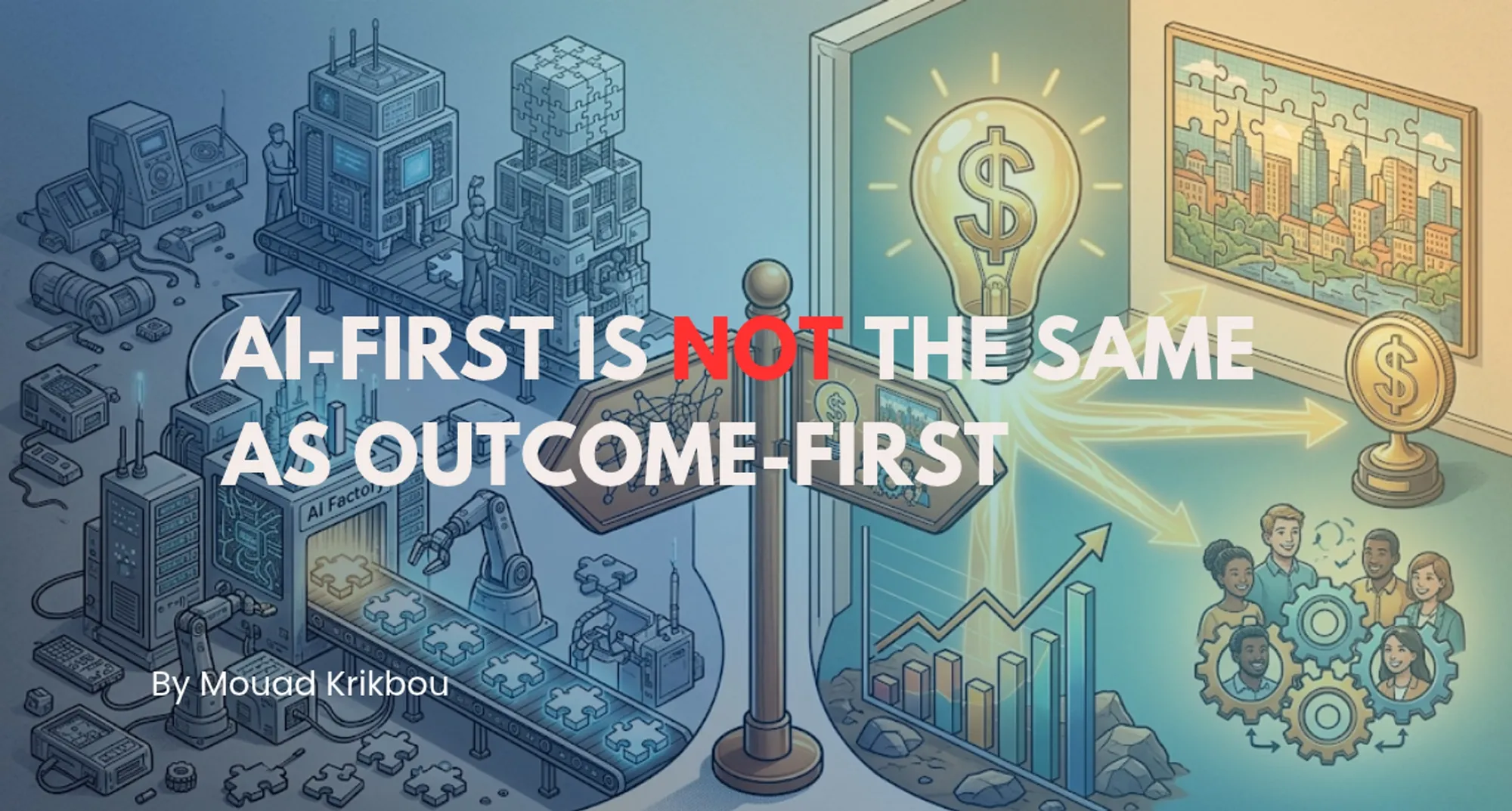
AI-First Is Not the Same as Outcome-First
Why the sequence of AI adoption matters more than the technology itself.
By Mouad Krikbou14 November 2026 · 20 min read
There are two ways to spend a year on AI, and I have watched both play out.
In the first, a company assembles a platform team, picks a framework, builds a shared capability layer, writes a governance charter and hires someone with AI in their title. Twelve months later the platform is real, the charter is signed, and no customer-facing process has changed. Everyone involved did competent work, and yet the year produced nothing anyone could point at and say: this is better than it was.
In the second, a team notices that one piece of work is eating its days: the research before the pitch, the reconciliation before the close, the review before the filing. They take that one piece, define it properly, clean up the data underneath it, and let a model do the part that does not need judgement. Six weeks later it works. Three months later two other teams want it. Nobody wrote a strategy deck; it spread because the people doing the work wanted to keep using it.
Both are years of AI work. Only one of them leaves a business that works differently.
As a solution architect, most of my work sits at the point where AI stops being an interesting demo and becomes something an organisation has to run, pay for, defend and maintain. From there, the variable that matters most is not the model. It is the order in which things get done.
This article is about that order: not which vendor, framework or architecture, but the sequence, and why it so often decides whether an investment produces anything durable. I am opinionated where I have conviction, and explicit where my advice does not apply. Some of what follows is established practice; some of it is decision logic I have built from watching these initiatives succeed and fail, and I keep the two apart.
The pattern I keep running into
It is easiest to see in three composites, each drawn from more than one organisation.
A bank has dozens of AI pilots, a central platform team, a governance council and someone with AI in their title. None of its customer-facing processes has changed.
A manufacturer spends a year and a half building a shared AI capability layer (tooling, reusable agents, standard infrastructure) before anyone establishes which factory-floor problem it was meant to solve.
A services firm rolls generative AI out to its entire workforce. The adoption dashboards look excellent. Nobody can tell me whether client outcomes improved.
None of these are technology failures. Each organisation had capable engineers and working infrastructure. What failed was the sequence: trying to build the perfect AI system before using AI to improve a real business outcome. Pilots, platforms, proofs of concept and governance artefacts accumulate, and the way work gets done stays the same.
There is a deeper version of the problem that I think gets less attention. Most companies never set out to change their operating model at all. They take AI capabilities and fit them into the process exactly as it exists: the workflow is untouched, and the AI is bolted on wherever it is convenient. That is not transformation, and it rarely produces a return. It produces a copilot nobody asked for and a benefit case nobody can defend.
So the question I keep returning to is not "where can we use AI?" It is this one:
“Are we deploying AI, or are we changing the work?”
The trap: optimising the system before validating the work
One failure mode deserves a name. It happens when an organisation confuses infrastructure readiness with business readiness.
Leaders invest in the platform before they understand the workflow. They standardise before they have discovered what actually repeats. They build reusable agents before there is any evidence that the work benefits from AI at all.
None of this is careless. It feels responsible, it looks like strategy, and it is what a mature organisation is expected to do; it can be defended in a board paper. But it is backwards. Building a highway before you know where people need to travel is still construction: you will get somewhere, though perhaps nowhere useful.
I separate readiness into three parts, though not as equal thirds:
- Technical readiness: the platform, the pipelines, the security posture.
- Operational readiness: the workflow, roles, incentives and change management.
- Evidence readiness: proof that the change improves a measurable outcome.
In my experience, most organisations overinvest in the first, underinvest in the second, and skip the third entirely.
I think of the first as the non-negotiables: what the system must have, and what you do not compromise on. In regulated environments that can include data isolation, audit trails, retention and residency. None of it is optional, and deferring it is how you end up rebuilding under pressure. Establish the floor, then stop talking about it.
After that, the real work is operational readiness and evidence, and the evidence exists to answer one question: is this transformation going in the direction we wanted? Not whether something happened, but whether the trajectory is the one we chose.
This dissolves a false debate. The question is not whether to build infrastructure first; it is which parts of it are non-negotiable, and which should wait until evidence justifies them. Those questions have different answers, and treating them as one is how organisations build highways to nowhere.
Standardise before you automate
This is where I go further than most adoption frameworks.
Before AI touches a process, the process should be standardised. I mean this the way I mean data quality, which comes before ingestion, extraction and classification: you do not classify data you have not cleaned, and you do not automate a process you have not defined.
If a process is inconsistent, undocumented and dependent on one person's judgement in ways nobody has put into words, the AI will learn the inconsistency. It will produce confident output from an undefined procedure. And when it fails, nobody will be able to say whether the fault lay in the model, the data or the process, because the process was never a stable thing to begin with.
Most adoption models put standardisation somewhere in the middle, after value has been proven and patterns discovered. I understand why: standardisation is slow, political and unglamorous, and nobody wants it on the first slide.
But it is a precondition, not a stage. The sequence runs: define the work, clean the data it depends on, then let AI in. Any other order produces a system that works in a demo and fails in production, for reasons that have nothing to do with AI.
Choosing the first problem
The starting question should not be where we can use generative AI. It should be where we are losing time, quality, revenue or the capacity to make decisions.
That sounds obvious, and yet most initiatives begin the other way round: with a capability in search of a problem (a chatbot, a copilot, an agent framework), and a use case reverse-engineered to fit it. That is how you get impressive demos and no business impact.
My own first filter is narrower and more practical than the usual lists. I ask: what keeps us from doing the main work?
Whatever that is, it is the first candidate. It might sit in a supporting process or inside the core one; the distinction matters less than the observation, because the people doing the work already experience it as friction. Nobody has to be convinced it is a problem.
Then I document the main tasks, and at each step I ask how an excellent employee would do it. If I can describe the steps, I can describe them to the AI, or build a system around them. If I cannot, that tells me something important: either the process needs standardising first, or the task genuinely requires judgement and probably calls for autonomy rather than automation.
Then I test and evaluate as hard as I can, until the result is either one people are highly satisfied with, or an acceptable one that saves enough time and cost for a person to build on.
An example I use often is sourcing and qualifying leads. Research and qualification are what keep a salesperson from the main work, which is the conversation. If AI sources and qualifies, the salesperson walks into a pitch with better leads and less time spent on research. Nobody automated the salesperson: the person kept the part that needs a person, and the AI took the part that was consuming their day.
The conventional filters are still useful as a checklist once there are candidates:
- Bounded: solvable in weeks, not quarters. If it needs a multi-year roadmap, it is a programme, not a first problem.
- Measurable: a baseline can be established and movement tracked.
- Consequential: it matters to the business, not only to the team.
- Repeatable: there is a chance of applying it elsewhere.
On core versus supporting processes, I am careful with the usual advice to start with supporting ones. It is often right, and often wrong for exactly the reason you would expect: the safe project is frequently the one nobody cares about. Start where the friction is, provided it is bounded and measurable. If that is inside the core process, so be it; just make sure the risk is understood and the blast radius is small.
And there is one question about exposure that I put to every proposal, and that cuts through most of the noise: who will want to use this, and how often?
If the answer is not "every day, because I need it and it makes my work better", it is probably a visibility product. Visibility products have their place. They should not be funded from a transformation budget.
Two dimensions, not one ladder
Automation and autonomy are often conflated, and I think the confusion causes real design mistakes. They are not the same thing, and they are not stages on the same ladder.
Automation removes a person from a step. Autonomy lets the system decide its own next step. Either can exist without the other: a fully automated data pipeline is not autonomous, and an agentic research assistant whose work a person approves at the end is not fully automated.
Neither is a goal in itself. Each has to be justified by necessity.
Automation is justified when the paths and the decision tree are clear. If you can draw the flowchart, exceptions included, you do not need judgement; you need a workflow, with the intelligence placed where it belongs, which is often in handling language inside a deterministic frame.
Autonomy is justified when the goal is known and measurable but the path is not: when the route depends on circumstances you cannot list in advance. An angry customer who jumps between topics is the classic case. The goal is clear (resolve the issue, keep the customer), but the path genuinely is not.
Everything else lies in between, and the honest answer there is usually a workflow with one or two decision points where a model may choose among a small set of pre-approved options.
The practical consequence is that "automate it" and "make it an agent" are not interchangeable instructions. They answer different questions: is the path clear, or only the goal?
The cycle: prove, discover, scale
What follows is my decision logic for sequencing. I call it a progress-to-automation cycle, though the name matters less than the shape. It is neither a waterfall nor a doctrine: it tells you where to start, not what you are forbidden to build.
It rests on the floor described earlier: the process defined, the data cleaned, the non-negotiables in place. Without that floor, everything above it is guesswork.
Prove. Demonstrate measurable value on one real, bounded problem, with the simplest AI-enabled workflow that can do the job. Establish a baseline before you start, and measure the result.
The goal here is evidence, not scale. The question is specific: does this work in our environment, with our data, our constraints and our people? A demo does not answer it, and neither does a pilot that never touches real work. Evidence comes from real work, real users and real outcomes.
Two entry points tend to work well. One is optimising internal tasks, which are low in risk, bounded and easy to measure. The other is automating boring, recurring processes such as invoice matching, ticket routing and data entry: high in volume, stable and repetitive, and often where the fastest return hides, because nobody has bothered to look.
Discover. Once value is proven in one place, look sideways: what recurs across similar tasks, teams or business units?
Two things need separating here. Components (retrieval, summarisation, classification, drafting) are often reusable. Workflows (how a contract is reviewed, how a complaint is resolved, how a compliance check is run) are usually specific to their context, and forcing them into one design produces a system that does everything adequately and nothing well.
My approach is deliberately staged. Design for one use case first. Then expand to a second, and see what actually transfers. Then look for the entities that might deserve to act independently.
That third step is the one people skip. A summarising agent that reads PDFs from a database is one entity. If it also connects to email and summarises threads, it may be a different entity, with different permissions, different failure modes and a different risk profile. The decision is not whether email can be added to the same agent; it is whether this should be the same agent at all.
Where reuse is legitimate, it is usually because the scenario is well known. An e-commerce refund platform is my standard example: the components are known, the decision tree is known, and a second refund pipeline can reuse most of the first while adding the edge cases that make it specific. Reuse is defensible there because the work is understood, not because two workflows look alike on a slide.
The test I apply is simple: reuse is a property of how well a scenario is understood, not of how similar it looks. Each core process should own its workflow independently, unless there is a genuine need to share state. Shared state is the only honest reason to couple two processes, and it is a much higher bar than convenience.
Scale. Automate a stable task when its benefits exceed the cost of implementing, maintaining and governing it, counting integration, oversight, change management and the ongoing cost of keeping it working.
Automation is the consequence of proven value, discovered patterns and standardised processes, not the goal. Scale when the economics justify it, when the risk is understood and governed, and when you have evidence rather than enthusiasm.
The metrics that matter, and the one most people leave out
Every initiative should be measured on four dimensions:
- Time: how much faster is the work done, measured against a baseline rather than a feeling?
- Cost: what does the whole workflow cost before and after, including integration, oversight, maintenance and change management? The price of the model is rarely the real cost.
- Quality: is the result better, worse or the same? Define quality before you start, or you will rationalise whatever comes out.
- Risk: what does it cost to be wrong? This decides how much oversight is needed, and whether automation is appropriate at all.
I add a fifth, and I think it is the one usually missing: forecast.
The point of measuring is not to report what happened but to decide what to do next. So the metrics have to tell you whether to continue or pivot, which means they must look forward and correlate directly with the return you forecast.
This is where I part company with most evaluation regimes. The metrics that matter are not historical; they are dynamic. When the model underneath changes, the efficiency of the system moves, and the question is no longer whether you are better than the original baseline. It is whether efficiency went up or down when the thing underneath you changed.
A baseline captured once, at the start of an initiative, is a museum piece. Models improve, prices fall, capabilities shift, and the system's efficiency moves with them. Metrics that cannot detect that movement leave you steering by a photograph.
So pick a small number of key metrics that correlate directly with the forecast return, and track their direction rather than their absolute value. The report that matters is a trajectory, not a snapshot.
After Action Review: the discipline that makes evidence real
Most organisations measure. Fewer learn.
After every experiment, the team answers four questions:
- What worked? Not what was supposed to work: what actually worked.
- What did not work? Not only what failed outright, but what produced no measurable improvement, or an improvement that could not be sustained.
- What should we do differently next time? Not a lesson learned, but a decision: scale, iterate or stop.
- If you were sure an alternative would work better, what would it be?
The fourth is my addition, and it does most of the work. The burden of proof sits on continuing. If someone can name a credible alternative that would outperform what has been built, that alternative is what we should be building. The only acceptable answer is "I do not think any alternative would work better". Anything else means it should stop.
Put that question to a room of people who own a project and watch what happens. Half the time you get a real answer, and it is the most useful thing said all quarter. The other half, you get the pause that tells you nobody has seriously asked whether the project should exist.
This is not a postmortem. It is a learning loop, and its output is not a report but a decision. Without the discipline, "scale or stop based on evidence" is a slogan on a slide; with it, the portfolio has teeth.
Governance by consequence, not by framework
Governance should be proportional to the cost of being wrong.
- Low consequence: drafting an internal memo, summarising a meeting, a first-pass analysis. Experiment quickly, with light oversight, and learn fast.
- Medium consequence: customer-facing communication, internal reporting, code generation. Require review, track quality, and establish escalation paths.
- High consequence: automated credit decisions, medical triage, compliance determinations. Strong validation, audit trails and named human accountability.
These tiers are guidelines, not a taxonomy. You can be as granular as the situation demands, and in a high-consequence context you probably should be. What matters is that the tier is chosen deliberately, from the consequence of an error, rather than inherited from a template.
The harder question is what makes a tier real. A framework document does not. Risk tiering without ownership is theatre, and avoiding that takes two things together: structural mechanisms (approval gates, scoped tool permissions, audit trails, enforced escalation paths) and explicit sign-off by named people who own the risk.
It takes both. The structure stops the careless failure; the named owner stops the deliberate one, and gives the whole arrangement a human face.
That human face matters to me beyond compliance. Customers trust people more readily than machines. When a decision goes wrong and someone has to answer for it, the answer has to come from a person who was accountable for it in advance. A system that cannot name that person has not been governed, only documented.
The portfolio: institutionalise first
This is what I would ask of a leadership team that is serious about it.
Institutionalise first. Before funding experiments, make sure there is a structure able to absorb what they produce: ownership, standards, and a way for something proven to become something supported. If no internal initiatives are running yet, that structure is what you build, and a central function is the right answer at that stage: it is the only way to create the first capability where none exists.
But the centre-of-excellence trap is real, and I have seen it close. A central function that owns every AI initiative becomes a bottleneck, then a gatekeeper, then an obstacle. The goal is to distribute capability while keeping standards: to enable, not to control. The teams closest to the work usually see the patterns first, and if they cannot act on what they see, they stop looking.
Seed. Once the structure exists, fund a small number of bounded experiments with clear owners and measurable outcomes. Start where the friction is, with internal tasks and recurring, boring processes.
Validate. Measure against a baseline with the metrics above, run the review with all four questions, and decide: scale, iterate or stop. Do not let pilots drift. A drifting pilot is the most expensive thing in this whole discipline, because it consumes attention without producing either a result or a lesson.
Propagate. Share validated patterns across functions, and make reuse easy. Distribute capability, not just control.
What is missing from the list is building a platform. That comes when there is something worth standardising, and not before, which brings us back to the sequence.
The questions I would ask before funding anything
I have cut this list down from the longer ones often recommended, because fewer questions tend to get answered honestly.
- Value: what measurable business outcome are we improving? Not which capability we are deploying, but which outcome moves.
- Evidence: what have we demonstrated in real work, rather than in a controlled demo? If the answer is nothing yet, that is fine: call it a research experiment and fund it as one, without the budget and expectations of a proven transformation.
- Economics: does scaling create net value after integration, oversight, maintenance and change management? That includes the ongoing cost of keeping it working, the line item everyone forgets.
- Ownership: who owns the outcome? A name, not a function.
I have deliberately left out repeatability. I used to include it, and I have changed my mind. Repeatability cannot be judged honestly before something has been built; it is a property you discover. What you can assess up front is whether the value is real and whether the evidence supports the claim, and when it does, repeatability tends to show up in the evidence. Asked as a separate gate, it mostly produces optimistic guesses dressed as analysis.
An initiative that cannot answer these questions can still be a legitimate experiment. It just should not be sold as a transformation.
The closing argument
In my view, the organisations that capture lasting value from AI will not be the ones with the biggest models, the most agents or the fastest standardisation. They will be the ones that turn real-world learning into repeatable business capability.
That means sequencing differently. Start with the work. Standardise it, and clean the data underneath it. Prove the value on something bounded. Discover what transfers and what does not. Then scale the system, once the economics and the risk justify it.
AI-first is not the same as outcome-first. The difference is not philosophical: it is the difference between a portfolio of impressive demos and a business that works differently from the way it did last year.
I will close with the analogy I use when explaining this to leadership teams, because it captures the timescale better than any framework.
Adopting AI is like adopting a child. You bring someone home to learn from your experience, to be taught, to be allowed to make mistakes and to grow into someone productive. You do not expect them to know everything on day one, or even to understand you on day one. You establish communication, a code of conduct and trust first, and only then does the productive individual emerge.
Organisations that treat AI adoption as a procurement exercise, expecting competence on delivery, get exactly what that expectation predicts. Those that treat it as a relationship, with a floor of non-negotiables, a standardised environment, honest evidence and the willingness to stop what is not working, are the ones that end up with something that lasts.
The progress-to-automation cycle is a decision logic, not a doctrine: use it to sequence, to prioritise, and to avoid building before learning. Measure time, cost, quality, risk and the direction of travel; review after every experiment, with the question that forces a decision; and scale only when the evidence supports it.
The goal is not to adopt AI everywhere first. It is to learn, faster than your competitors, which applications create durable value.
References and further reading
The argument here comes largely from practice, and from the architecture described in my earlier article, Anatomy of a Production AI System. Where it touches established frameworks, these are the sources I would point a reader to.
NIST (2023). Artificial Intelligence Risk Management Framework (AI RMF 1.0), NIST AI 100-1. National Institute of Standards and Technology, January 2023. For the Govern, Map, Measure and Manage functions that underlie the risk tiers.
NIST (2024). Artificial Intelligence Risk Management Framework: Generative Artificial Intelligence Profile, NIST AI 600-1. National Institute of Standards and Technology, July 2024. For human-AI configuration and accountability.
OWASP GenAI Security Project (2024). OWASP Top 10 for LLM Applications 2025. Published November 2024. For guardrails, excessive agency and the boundary controls behind the governance section.
U.S. Army (1993). A Leader's Guide to After-Action Reviews, Training Circular 25-20. Headquarters, Department of the Army. Where the After Action Review comes from; the four questions here are my own variant.
A note on sourcing: the composites in the opening sections are patterns rather than specific, attributable cases, and the metrics, tiers and sequencing in this article are my own decision logic, not findings from a controlled study. I have kept the references to documents I can point to directly, and I would rather leave a claim uncited than attach a citation that does not hold up.